110+ PR statistics for 2026: journalists, press releases, media trust and AI search (Updated October)

Natia Kurdadze
Founder

By Natia Kurdadze · Updated 22 October 2026
You shipped the launch. The post got 40 likes. Nobody wrote about it, and when someone asks ChatGPT about your category, you don’t exist. That gap between shipping and being talked about is what PR is supposed to close, and the numbers below show how much the job has changed in two years.
Every figure on this page comes from the organization that collected it: government labor data, newsroom surveys, AI citation studies and long-running trust polls. Each link was opened and checked on 21 and 22 October 2026. If you want your own story in the outlets these numbers describe, see what a Diptell placement looks like.
Key takeaways
Earned media accounts for 84% of AI citations across ChatGPT, Claude and Gemini. If AI answers are where buyers start, coverage in real publications is the input that shapes those answers. (Muck Rack, May 2026)
86% of journalists say at least some of their stories start with a PR pitch. PR still feeds the newsroom, but only when the pitch fits the beat. (Muck Rack, March 2026)
Press releases grew from 1.2% to about 6% of AI citations between July and December 2025. Releases are becoming a source AI engines actually read, not just a wire formality. (Muck Rack, December 2025)
Google users clicked a traditional result in 8% of visits when an AI summary appeared, versus 15% without one. Ranking alone now earns roughly half the clicks it used to on queries with a summary. (Pew Research Center, July 2025)
Brands cited in Google AI Overviews earned 35% more organic clicks and 91% more paid clicks than brands left out. The study is correlational, but being the cited source is the only position in the overview that still pulls traffic. (Seer Interactive, September 2025)
314,500 people worked as public relations specialists in the US in 2025. The profession is large and stable, while the newsroom it pitches keeps shrinking. (U.S. Bureau of Labor Statistics, August 2026)
33% of Americans trust the mass media a great deal or a fair amount, up from a record low of 28% in 2025. Trust is recovering slightly but remains less than half of what it was in the 1970s. (Gallup, September 2026)
PR industry and workforce statistics
The PR profession is large, steady and busier than ever. These numbers cover how many people do the work, what it pays, and what budgets and teams look like going into 2027.
Figure 1: Median annual pay, May 2025. Source: U.S. Bureau of Labor Statistics, August 2026 and BLS reporters profile
Jobs and pay
314,500 people worked as public relations specialists in the US in 2025. The profession is large and stable, while the newsroom it pitches keeps shrinking. (U.S. Bureau of Labor Statistics, August 2026)
The median US PR specialist earned $74,750 a year in May 2025, compared with $50,980 across all occupations. PR pays well above the national median, which is part of why in-house PR is expensive for early-stage companies. (U.S. Bureau of Labor Statistics, August 2026)
PR specialist employment is projected to grow 2% from 2025 to 2035, slower than the 3% average for all occupations. Demand is holding, but the job is not expanding fast, so teams are being asked to do more with the same headcount. (U.S. Bureau of Labor Statistics, August 2026)
About 23,000 PR specialist openings are projected each year through 2035. Most of those openings replace people who retire or change careers rather than adding new seats. (U.S. Bureau of Labor Statistics, August 2026)
US newsrooms employed 47,100 news analysts, reporters and journalists in 2025. Set against BLS’s 314,500 PR specialists, that works out to roughly 6.7 PR people for every reporter, a ratio we calculated from the two BLS profiles. (U.S. Bureau of Labor Statistics, August 2026)
Reporter jobs are projected to shrink 6% between 2025 and 2035, a loss of about 2,800 positions. Fewer reporters means every pitch competes for a smaller pool of attention each year. (U.S. Bureau of Labor Statistics, August 2026)
Budgets and team size
More than half of 1,100+ PR professionals surveyed by Meltwater expect little or no change in PR investment for 2026. Flat budgets with rising expectations push teams toward channels with predictable cost per placement. (Meltwater, January 2026)
Nearly 40% of PR professionals say company leadership has a limited understanding of their team’s work. When leaders cannot see the output, PR budgets are the first to be questioned, so visible results matter. (Meltwater, January 2026)
Half of the PR teams in Meltwater’s survey have fewer than 5 members. Small teams cannot run media relations, content, social and measurement in house at the same depth, which is why outsourcing pieces of the work is common. (Meltwater, January 2026)
About 60% of digital PR teams work with monthly budgets under $10,000, and 25.7% with less than $5,000. BuzzStream’s sample of 150+ practitioners skews to the UK, so treat this as a directional benchmark for smaller teams. (BuzzStream, 2026)
Workload and AI adoption
Over 90% of PR teams have already built generative AI into their workflows. AI is now table stakes for drafting and research, so speed alone is no longer a differentiator. (Meltwater, January 2026)
Over 40% of PR teams still measure activity instead of business outcomes. Counting emails sent rather than coverage won and traffic earned is the measurement gap leadership notices. (Meltwater, January 2026)
66% of PR professionals rated their work stress as high in Muck Rack’s 2026 survey. The workload is real, and it is one reason founders look for packaged, predictable PR instead of building a function from scratch. (Muck Rack, July 2026)
75% of digital PR professionals say the work is more challenging in 2026 than it was in 2025. This is self reported by practitioners, but it matches what journalists report about pitch overload below. (BuzzStream, 2026)
Pay range, hours and proving value
The top 10% of US PR specialists earn more than $135,150 a year, while the bottom 10% earn less than $44,110. Pay spans a threefold range, so what PR costs depends heavily on seniority. (U.S. Bureau of Labor Statistics, August 2026)
PR specialists in government earned a median $81,350 in May 2025, ahead of the $77,480 median in advertising and PR agencies. Agency salaries set the floor for what outsourced PR has to charge. (U.S. Bureau of Labor Statistics, August 2026)
84% of PR professionals say media relations makes up at least a quarter of their job. Pitching is still the core of the work, even as content and measurement tasks grow around it. (Muck Rack, July 2026)
55% of PR professionals worked more than 40 hours in the week before the survey, and 77% worked after hours at least once. Long weeks are normal in PR, which makes predictable, packaged work attractive to small teams. (Muck Rack, July 2026)
69% of PR professionals say producing measurable results is the best way to raise PR’s standing with leadership. Placements you can link to and count are easier to defend than activity reports. (Muck Rack, July 2026)
36% of PR professionals say their PR budget depends on the CEO. For many companies, PR spend is a founder decision, so the case has to be made in business terms. (Meltwater, January 2026)
68.2% of digital PR professionals say digital PR is more effective than it was 12 months ago. Practitioners report both harder work and better results, a sign the channel is maturing rather than fading. (BuzzStream, 2026)
More than 40% of B2B deals stall because of internal misalignment within buying groups. Third-party coverage every stakeholder can find on their own helps align the people a founder never meets. (Edelman and LinkedIn, 2025)
Journalist and newsroom statistics
Journalists still use PR every day, but they are fewer, busier and quicker to delete. This section covers how stories start, how crowded inboxes are, and how fast local newsrooms are disappearing.

Figure 2: How journalists treat PR material. Source: Muck Rack, March 2026 and Cision, May 2026
How stories start
86% of journalists say at least some of their stories start with a PR pitch. PR still feeds the newsroom, but only when the pitch fits the beat. (Muck Rack, March 2026)
66% of journalists rely on PR-provided content such as press releases, pitches and media kits for story ideas. Cision surveyed 1,899 journalists in January and February 2026, which makes PR the leading source of story leads in its data. (Cision, May 2026)
50% of journalists name accuracy, fact checking and fighting misinformation as their top challenge. Pitches with verifiable data and named sources make a reporter’s hardest job easier. (Cision PR Newswire, May 2026)
Pitch overload
88% of journalists immediately disregard pitches that miss their beat. Relevance is a filter, not a bonus, so a smaller targeted list beats a big blast. (Muck Rack, March 2026)
72% of journalists say fewer than a quarter of the pitches they receive are relevant to their work. Most pitches fail before the subject line is finished, which is why guaranteed placement formats appeal to founders. (Cision, May 2026)
Most journalists receive 50 or more pitches a week. At that volume, a pitch gets seconds of attention, so the angle has to be obvious from the first line. (Cision PR Newswire, May 2026)
53% of journalists oppose AI-generated pitches, citing accuracy and personalization. AI can speed up drafting, but a pitch that reads machine written works against you. (Cision, May 2026)
62% of journalists use LinkedIn, and 33% call it the single most valuable network for their work. A founder’s LinkedIn presence is part of how reporters vet a source before replying. (Cision PR Newswire, May 2026)
Newsrooms shrinking
213 US counties were news deserts in 2025, up from 206 in the previous year’s report. Every closed local outlet is one fewer place a regional story can land. (Medill, October 2025)
Another 1,524 US counties have only one remaining local news source. In those markets a single editor decides whether a local business gets covered at all. (Medill, October 2025)
250 counties are at high risk of becoming news deserts within the next decade. This is a forecast from a predictive model, so treat it as a risk estimate rather than a count. (Medill, October 2025)
About 150 US counties were news deserts 20 years ago. The number of counties with no local news has grown by roughly 40% since then, based on Medill’s own counts. (Medill, October 2025)
70% of US counties are severely undercovered, with below-average numbers of local journalists. The index counts part-time and freelance work too, so the real staffing gap is likely no smaller than this. (Rebuild Local News, June 2026)
Journalists, AI and platforms
47% of journalists use ChatGPT, while Gemini use rose from 13% to 22% and Claude use doubled from 6% to 12%. Reporters now check claims with the same AI tools your buyers use, so facts in a pitch need to hold up. (Muck Rack, March 2026)
Only 21% of journalists say social media is very important to producing their work, down 12 points since 2024. Social is now mostly a promotion channel for reporters, not where they find stories. (Muck Rack, March 2026)
58% of journalists trust LinkedIn to treat journalistic content fairly, while 61% call TikTok untrustworthy. LinkedIn is where reporters and founders overlap, which makes it the best social channel for PR. (Muck Rack, March 2026)
78% of journalists say a pitch feels genuinely relevant when it affects the community their audience belongs to. Relevance is about the reader, not just the beat, so frame the story around who it touches. (Muck Rack, March 2026)
Disinformation and lack of funding tie as the top threats to journalism, each named by 32% of journalists. Underfunded newsrooms lean harder on ready-to-use, verifiable material from PR. (Muck Rack, March 2026)
Only 21% of journalists say they have not used AI in their work, and 43% call AI’s impact on journalism their top challenge. AI is standard in newsrooms, and reporters are wary of pitches that read machine made. (Cision PR Newswire, May 2026)
Newspaper publishers employ 28% of US reporters, and 17% of reporters are self-employed. Freelancers write a growing share of coverage, so the right contact is not always on a masthead. (U.S. Bureau of Labor Statistics, August 2026)
Reporters at streaming and online media companies earn a median $80,180, against $49,220 at newspaper publishers. Talent and budgets are moving to digital outlets, which is where most placements now land. (U.S. Bureau of Labor Statistics, August 2026)
Press release and pitching statistics
Press releases were declared dead for a decade, and the data says otherwise. This section covers what journalists want from PR, how PR teams pitch, and how releases now show up inside AI answers.
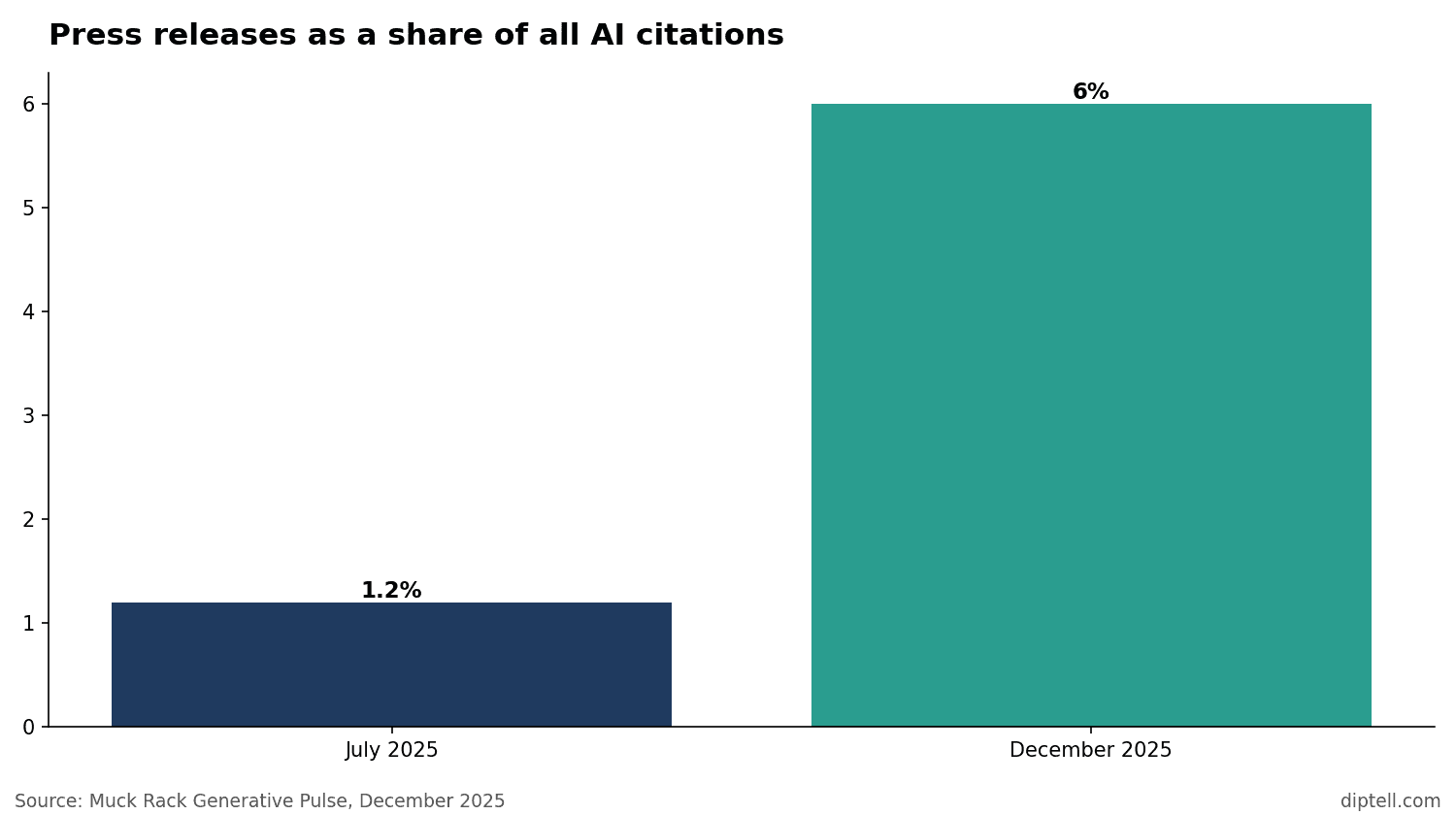
Figure 3: Press releases as a share of all AI citations. Source: Muck Rack, December 2025
Do journalists still want press releases
74% of journalists said press releases and news announcements are what they most want from PR professionals. This comes from Cision’s 2024 survey, the most recent edition that published the figure, so treat it as a recent baseline. (Cision, 2024)
68% of journalists found press releases the most useful resource for content ideas, ahead of direct pitches at 47%. A clear, factual release still outperforms a clever pitch as raw material. (Cision, 2024)
Just 2% of journalists prefer to be pitched through social media direct messages. Email remains the channel; DMs are for relationships that already exist. (Cision, 2024)
How PR teams pitch
49% of PR professionals pitch more than 20 journalists per campaign or announcement. Wide lists persist even though journalists say relevance is what gets a reply. (Muck Rack, July 2026)
71% of PR professionals cite low journalist response rates as a top earned media challenge. Silence is the default outcome of cold pitching, which is why placement certainty has become a selling point. (Muck Rack, July 2026)
61% of PR professionals point to smaller or shrinking media lists in their beats. Fewer reachable reporters per topic matches the newsroom decline in the section above. (Muck Rack, July 2026)
Only 10.1% of digital PR teams say they work most closely with PR teams, down from 14.5% in 2025. Digital PR and traditional PR still run as separate functions in most companies, even as their goals converge. (BuzzStream, 2026)
Press releases in AI answers
Press releases grew from 1.2% to about 6% of AI citations between July and December 2025. Releases are becoming a source AI engines actually read, not just a wire formality. (Muck Rack, December 2025)
Citations pointing directly to PR Newswire, Business Wire and GlobeNewswire rose fivefold, from 0.2% to 1% of all AI citations. Wire-hosted copies are only part of the story; most cited releases live on the outlets that republish them. (Muck Rack, December 2025)
On average, only 2% of the journalists PR teams pitch most overlap with the journalists AI engines cite for a brand. The people who shape AI answers about you are mostly not on your current media list. (Muck Rack, December 2025)
Press releases appear in AI answers to industry trend questions at 3.5 times the rate seen in best-of queries. Releases tied to a trend or data point have the best chance of being cited. (Muck Rack, May 2026)
How PR teams personalize
66% of PR professionals usually or always personalize their pitches, down from 70% a year earlier. Personalization is slipping just as journalists say relevance is what earns a reply. (Muck Rack, July 2026)
73% of PR pros who personalize only change a few sentences, while 15% tailor every part of the pitch. Light edits rarely survive a reporter’s first read, which is why most pitches still miss. (Muck Rack, July 2026)
91% of PR professionals commonly pitch online and digital outlets, while 57% pitch podcasts. Digital outlets are the default target, and they are also what AI engines read. (Muck Rack, July 2026)
77% of journalists said they may block a PR practitioner who spams them with irrelevant pitches. One careless blast can close a door for good, a 2024 finding that the 2026 data on relevance only reinforces. (Cision, 2024)
Earned media and AI citation statistics
AI assistants are now a front door to brand discovery, and they lean heavily on published coverage. This section covers what AI engines cite, how each platform behaves, and why freshness and authority matter.

Figure 4: Average links cited per AI answer, when the model cites. Source: Muck Rack, May 2026
What AI engines cite
Earned media accounts for 84% of AI citations across ChatGPT, Claude and Gemini. If AI answers are where buyers start, coverage in real publications is the input that shapes those answers. (Muck Rack, May 2026)
Paid and advertorial content makes up just 0.3% of AI citations. Buying ads does almost nothing for how AI describes your brand; being covered does. (Muck Rack, May 2026)
Journalism alone accounts for 27% of all links AI engines cite. News outlets are the single biggest category AI leans on, across more than 25 million analyzed links. (Muck Rack, May 2026)
How each platform cites
ChatGPT cites sources in 96% of responses with about 5 links each, Gemini in 82% with 8, and Claude in 55% with 13. Each assistant has its own citation habits, so visibility in one does not guarantee visibility in the others. (Muck Rack, May 2026)
Most AI citations for any given brand come from just 20 outlets. A focused outlet list can move AI visibility more than broad coverage, but every brand’s 20 are different. (Muck Rack, December 2025)
42% of people who use AI chatbots for news say they always or often click through to the original source. Self reported click-through may run higher than real behavior, but the cited outlet still gets a share of the attention. (Reuters Institute, June 2026)
Freshness and authority
More than half of AI citations point to content published in the last 12 months. Coverage decays as an AI signal, so one placement a year is not enough to stay visible. (Muck Rack, December 2025)
About 4% of Claude and ChatGPT citations come from articles published in the past week, the highest concentration of any time window. Fresh coverage gets an immediate boost, which favors a steady cadence of announcements. (Muck Rack, December 2025)
73% of PR professionals say generative engine optimization matters at least somewhat to their strategy, yet 29% say nobody owns it. AI visibility is recognized as important but still sits between PR, SEO and marketing in most companies. (Muck Rack, July 2026)
55% of PR professionals are securing coverage in high-authority publications specifically to show up in AI answers. Practitioners are already treating top-tier placements as an AI visibility tactic, not only a reputation one. (Muck Rack, July 2026)
Inside the citation data
About 94% of links cited by AI came from non-paid sources and 82% from earned media in December 2025. Across two editions six months apart, the earned share barely moved. (Muck Rack, December 2025)
51% of AI answers that cite Reddit also cite a journalistic source. Even community threads get grounded with reporting, so coverage travels with the conversation. (Muck Rack, December 2025)
Citations to management consulting firms fell 35% between July and December 2025. Citation habits shift fast, so a one-time AI visibility audit goes stale within months. (Muck Rack, December 2025)
Earned media’s share of AI citations has stayed between 82% and 89% across three editions since July 2025. The pattern is stable across model updates, which makes earned coverage a durable AI strategy. (Muck Rack, May 2026)
Journalism citations are spread across more than 20,000 distinct outlets. AI does not only read the biggest names, so niche and trade outlets in your category count too. (Muck Rack, May 2026)
Axios appears in ChatGPT’s top three cited domains in 13 of 17 industries, the only news outlet to do that on any platform. Neither the New York Times nor Reuters made a top three, so outlet prestige and AI weight are not the same thing. (Muck Rack, May 2026)
39% of PR professionals are not measuring generative engine optimization at all, and 25% track brand mentions in AI answers. Most teams cannot yet show whether their coverage changes what AI says about them. (Muck Rack, July 2026)
PR and communications teams own GEO at 24% of organizations, ahead of SEO or content teams at 15%. AI visibility is landing with PR more often than with SEO, which shifts budget toward earned media. (Muck Rack, July 2026)
Search clicks and zero click statistics
Ranking first used to guarantee traffic. These numbers show how AI summaries changed what a top position is worth and where attention is moving instead.

Figure 5: What Google users did next, March 2025. Source: Pew Research Center, July 2025
AI Overviews and click-through
Google users clicked a traditional result in 8% of visits when an AI summary appeared, versus 15% without one. Ranking alone now earns roughly half the clicks it used to on queries with a summary. (Pew Research Center, July 2025)
Users clicked a link inside the AI summary itself in just 1% of visits. Being cited in the summary builds awareness more than it builds traffic. (Pew Research Center, July 2025)
Users ended their browsing session on 26% of pages with an AI summary, compared with 16% of pages without one. For many searches the summary is the final answer, so the brand named in it wins the moment. (Pew Research Center, July 2025)
Organic click-through on queries with an AI Overview fell from 1.76% to 0.61%, a 61% drop. Seer’s data covers 3,119 informational queries, so commercial queries may behave differently. (Seer Interactive, September 2025)
Paid click-through on queries with an AI Overview fell 68% over the same period. Buying the top slot does not escape the effect either. (Seer Interactive, September 2025)
Organic click-through fell 41% even on queries without an AI Overview. Clicks are falling everywhere, which suggests attention is moving to AI assistants and social platforms, not just to the overview. (Seer Interactive, September 2025)
Brands cited in Google AI Overviews earned 35% more organic clicks and 91% more paid clicks than brands left out. The study is correlational, but being the cited source is the only position in the overview that still pulls traffic. (Seer Interactive, September 2025)
AI Overviews now correlate with a 58% lower click-through rate for the top-ranking page, up from 34.5% in Ahrefs’ earlier study. Measured across 300,000 keywords with December 2025 data, the effect roughly doubled in eight months. (Ahrefs, February 2026)
Pages ranking second lost about half their clicks when an AI Overview appeared, and pages ranking tenth lost nearly 20%. The whole first page is affected, not only position one. (Ahrefs, May 2026)
What AI summaries link to
18% of Google searches in Pew’s March 2025 data produced an AI summary. Longer and question-style searches trigger summaries far more often, and those are the searches buyers use when researching. (Pew Research Center, July 2025)
Wikipedia, YouTube and Reddit together made up 15% of the sources linked in Google’s AI summaries. A handful of platforms dominate, so third-party coverage on credible sites is how smaller brands get a seat. (Pew Research Center, July 2025)
5% of the sources linked in AI summaries were news websites, while 6% were .gov sites. News is a minority of summary links in general search, which makes it more valuable when a brand appears in one. (Pew Research Center, July 2025)
Where attention is moving
Google organic search traffic to more than 2,500 news sites fell 33% globally between November 2024 and November 2025, and 38% in the US. The figures come from Chartbeat data reported by the Reuters Institute, and publishers feel the drop directly. (Reuters Institute, June 2026)
News publishers expect traffic from search engines to fall 43% over the next three years. This is an expectation, not a measurement, but it shapes how outlets prioritize content and partners. (Reuters Institute, June 2026)
ChatGPT reached 900 million weekly active users and 50 million paying subscribers in February 2026. This is a company-reported figure, but the scale explains why AI answers now matter as much as search rankings. (TechCrunch, February 2026)
Gartner forecast in 2024 that traditional search engine volume would drop 25% by 2026 as AI chatbots take queries. This is a forecast, not measured data; the click studies above are the reality check. (Gartner, February 2024)
Zero-click baseline and who sees AI summaries
For every 1,000 Google searches in the US, only 360 clicks reach the open web, outside Google’s own properties and ads. This 2024 clickstream baseline predates the wider AI Overviews rollout, so the share today is likely lower. (SparkToro, July 2024)
In the EU, 374 of every 1,000 Google searches send a click to the open web. Regulation has done little to change the picture; most searches stay inside Google on both sides of the Atlantic. (SparkToro, July 2024)
63% of US Google searches happen on mobile devices. Small screens push answers above the fold, which is exactly where AI summaries sit. (SparkToro, July 2024)
58% of people in Pew’s panel ran at least one Google search in March 2025 that produced an AI summary. Most searchers had already met AI answers within a single month of tracking. (Pew Research Center, July 2025)
53% of searches with 10 or more words produced an AI summary, against 8% of one or two word searches. Detailed research queries, the kind buyers type before choosing a vendor, are the ones most likely to be answered by AI. (Pew Research Center, July 2025)
60% of searches that began with a question word such as who, what or why produced an AI summary. Question-style content and coverage that answers a question directly fits how these summaries are triggered. (Pew Research Center, July 2025)
88% of AI summaries cited three or more sources, and the median summary was 67 words long. A short answer built from several sources leaves room for a brand that appears across more than one outlet. (Pew Research Center, July 2025)
Media trust and news consumption statistics
Trust in news is low and news habits are moving to platforms. This section covers how much people trust the media, where they get news now, and the role AI is starting to play.

Figure 6: US trust in mass media, selected years 1972 to 2026. Source: Gallup, September 2026
Trust in news
33% of Americans trust the mass media a great deal or a fair amount, up from a record low of 28% in 2025. Trust is recovering slightly but remains less than half of what it was in the 1970s. (Gallup, September 2026)
68% of Americans trusted the mass media when Gallup first asked in 1972. The long decline means a media mention is a credibility signal precisely because trust is now scarce. (Gallup, September 2026)
33% of Americans say they have no trust at all in the mass media. A third of any audience is skeptical by default, so coverage works best alongside proof like customer results. (Gallup, September 2026)
Trust in the media stands at 22% among Republicans, 31% among independents and 50% among Democrats. Trust varies sharply by audience, so the right outlet depends on who you sell to. (Gallup, September 2026)
Only 6% of Americans trust the mass media a great deal. Strong trust is rare, which is why established outlets carry outsized weight when they do mention a brand. (Gallup, September 2026)
Trust in news across 48 markets fell to 37%, the lowest since the Reuters Institute began measuring in 2015, and to 25% in the US. Trust in the most widely used individual news brands is holding up better than trust in news overall. (Reuters Institute, June 2026)
Where people get news
54% of people now use social media and video networks for news, ahead of news websites and apps at 51% and TV at 52%. Coverage now travels through platforms, so placements that get shared reach further than the outlet’s own audience. (Reuters Institute, June 2026)
AI as a news source
10% of people use AI chatbots for news each week, up from 7% a year earlier, rising to 16% of under-35s. Growth is fast rather than explosive, but the youngest audiences are adopting first. (Reuters Institute, June 2026)
Platforms, creators and attention
30% of people say social media and video networks are their main source of news, up from 22% five years ago. Coverage increasingly reaches people as a shared link or clip rather than a homepage visit. (Reuters Institute, June 2026)
52% of 18 to 24 year olds say social media, video networks and AI chatbots are their main way of getting news. For younger buyers, coverage matters most once it is shared, clipped or summarized by AI. (Reuters Institute, June 2026)
Facebook is used for news by 43% of people, YouTube by 34%, Instagram by 26% and TikTok by 20%. Each placement is worth more when it is cut into posts for the platforms your buyers actually use. (Reuters Institute, June 2026)
27% of people got news from news-focused creators in the past week, and 46% from creators of any kind. Creators sit alongside outlets rather than replacing them, so both belong in a visibility plan. (Reuters Institute, June 2026)
62% of people worry about what is real and fake online, up 4 points in a year. In a skeptical feed, a mention from a recognized outlet does work a brand’s own post cannot. (Reuters Institute, June 2026)
42% of people sometimes or often avoid the news, up from 29% when the Reuters Institute first asked in 2017. Many buyers skip the news entirely, so coverage needs a second life on your site, socials and sales decks. (Reuters Institute, June 2026)
77% of people now watch online news video each week. Video and podcast distribution extends a story to audiences who will never read the article. (Reuters Institute, June 2026)
39% of American women trust the mass media, against 28% of men. Audience makeup changes how much weight a media mention carries with your buyers. (Gallup, September 2026)
38% of Americans aged 55 and older trust the mass media, against 34% of 18 to 34 year olds and 27% of 35 to 54 year olds. The mid-career group most likely to sign B2B contracts is the least trusting, so pair coverage with proof. (Gallup, September 2026)
What these PR statistics mean in practice
The numbers point to a few practical moves for founders and marketers.
Get covered where AI is reading
Earned media drives the large majority of AI citations, and recent coverage counts most. A steady cadence of placements in credible outlets does more for AI visibility than one big launch a year. That is the gap a flat-priced placement package is built to close.
Write releases around a trend or a number
Releases tied to industry trends get cited far more often in AI answers than generic announcements. Lead with a data point, keep it factual, and make the angle obvious in the first line.
Stop blasting, start matching
Journalists delete off-beat pitches and most say very few pitches are relevant. If you pitch directly, build a short list of reporters whose beat matches your story, including the ones AI already cites in your category.
Measure outcomes, not activity
Track coverage won, AI mentions and referral traffic rather than emails sent. Leadership notices results, and the data shows many PR teams still report activity.
FAQ
Do journalists still use press releases?
Yes. 66% of journalists rely on PR-provided content, including press releases, for story ideas (Cision, May 2026), and press releases grew from 1.2% to about 6% of AI citations in the second half of 2025 (Muck Rack, December 2025).
What share of AI citations come from earned media?
84% of AI citations across ChatGPT, Claude and Gemini come from earned media, and paid content accounts for 0.3% (Muck Rack, May 2026).
How much do AI Overviews reduce clicks?
Pew found users clicked a traditional result in 8% of visits with an AI summary versus 15% without one (Pew Research Center, July 2025), and Ahrefs measured a 58% lower click-through rate for the top-ranking page (Ahrefs, February 2026).
How many PR specialists are there compared with journalists?
BLS counts 314,500 PR specialists (BLS, August 2026) and 47,100 news analysts, reporters and journalists in the US (BLS, August 2026), about 6.7 PR people per reporter.
How much do Americans trust the media?
33% trust the mass media a great deal or a fair amount as of September 2026, up from a record low of 28% in 2025 (Gallup, September 2026).
Methodology and sources
About 150 candidate figures were checked against their original publications and 116 were kept. Stats found on roundup pages were traced back to the organization that collected the data, and anything without a reachable primary source was dropped. Unlike samples were never averaged, and older or forecast figures are labeled as such. Citation dates reflect the original publication or data release. Every URL was opened and checked on 21 and 22 October 2026; one ratio (PR specialists per reporter) is our own calculation from two BLS profiles.
Sources
BLS PR specialists (Aug 2026)
BLS news analysts and reporters (Aug 2026)
Meltwater State of PR release (Jan 2026)
Meltwater State of PR guide (2026)
Meltwater key takeaways (Jan 2026)
BuzzStream State of Digital PR (2026)
BuzzStream digital PR statistics (2026)
Muck Rack State of PR (Jul 2026)
Muck Rack State of Journalism (Mar 2026)
Cision State of the Media (May 2026)
Cision PR Newswire takeaways (May 2026)
Cision State of the Media 2024 findings
Medill State of Local News (Oct 2025)
Rebuild Local News Local Journalist Index (Jun 2026)
Muck Rack What Is AI Reading (Dec 2025)
Muck Rack Generative Pulse (May 2026)
Pew AI summaries and clicks (Jul 2025)
Seer Interactive AIO CTR (Sep 2025)
Ahrefs AI Overviews update (Feb 2026)
Ahrefs via Business Wire (May 2026)
TechCrunch ChatGPT users (Feb 2026)
Gartner search forecast (Feb 2024)
Gallup trust in media topline (Sep 2026)
Reuters Institute Digital News Report (Jun 2026)
SparkToro 2024 zero-click study (Jul 2024)
Edelman and LinkedIn B2B Thought Leadership Impact Report (2025)
Cite this page
Diptell, “110+ PR statistics for 2026: journalists, press releases, media trust and AI search,” October 2026, https://diptell.com/pr-statistics/.


